Building Capacity for Patient-Centered Clinical Comparative Effectiveness Research (CER) in Rare Lung Disease
Funded through a Patient-Centered Outcomes Research Institute (PCORI) Eugene Washington PCORI Engagement Award (EASO-42389)
About the Project
Children's Interstitial and Diffuse Lung Disease (chILD) includes rare pulmonary disorders that cause significant morbidity and mortality. These heterogeneous conditions vary in severity, age of onset, and prognosis, with some children requiring minimal support while others face life-threatening challenges or need lung transplantation. Families often struggle with accessing specialized care and managing their child's developmental and emotional needs, alongside finding effective treatments. Additionally, there is limited data on long-term outcomes, including mental health and quality of life. A collaborative, patient-centered approach is vital to address the diverse needs of this population.
chILD disorders represent a significant unmet need in research and treatment. This project aims to establish a collaborative patient-centered clinical effectiveness research (CER) program focused on chILD. By engaging patients, caregivers, and clinicians, the goal is to empower stakeholders, enhance patient care, and create sustainable research addressing the unique challenges faced by those affected by chILD.
Objective: To establish a sustainable, patient-centered CER program for chILD.
- Patient-Centered Research Community – Establish a collaborative network of patients, caregivers, clinicians, and researchers from multiple chILD centers. All members will complete the PCORI Research Fundamentals curriculum and participate in chILD-specific stakeholder webinars.
- Stakeholder Engagement – Two cycles of virtual engagement studios, focus groups, and in-person meetings to generate conceptual models, prioritize research questions, and ensure patient and caregiver perspectives guide the process.
- Annual Hybrid Meeting – Brings stakeholders together each year to prioritize research questions and develop research infrastructure and long-term sustainability plans.
- Dissemination – The research priorities and interests and engagement strategies will be shared via virtual meetings, publications, and our website, reaching both the chILD and broader rare disease communities.
Short-Term (Project Period)
- A diverse, engaged research community trained to participate in CER.
- Completion of the stakeholder engagement process and identification of prioritized CER questions.
- A comprehensive CER research priorities and interests for chILD disorders.
Medium-Term (0–2 Years Post-Project)
- Ongoing dissemination of results through virtual meetings, publications, and social media.
- Continued engagement of the CER community and growing investment in chILD research.
- Raised awareness of CER-trained stakeholders available to collaborate on future projects.
Long-Term (3+ Years Post-Project)
- A sustained program of patient-centered CER focused on improving outcomes for all forms of chILD.
- Empowerment of patients and families to actively participate in research and decision-making.
- Improved outcomes and quality of life for chILD patients across all stages of life.
This project will involve patients, caregivers, clinicians, and researchers from the outset. A Project Oversight Team, including physicians, a parent outreach coordinator, and stakeholder leaders, will guide the project's direction. Stakeholders will be recruited through our Parent/Patient Advisory Committee, online communities, and social media. Physicians and allied health professionals will be drawn from our existing research network. This inclusive, collaborative approach ensures that the voices of patients and families are central to the research process.
Project Oversight Team
- Ann Gettys, Project Lead
- Holly James – Administrative Official
- Elizabeth Fiorino – chILD Board Member
- Dr. Jennifer Wambach – St. Louis
- Dr. Alicia Casey – BCH
- Dr. Deborah Liptzin – University of Washington
- Dr. Gregory Sawicki – BCH (IRB support)
- Jean Schmit-Gill, Parent Community Coordinator
Evaluation and IRB oversight in collaboration with Boston Children's Hospital.
Stakeholder Leadership Team
- Cara Favuzza – Adult patient and RN
- Angel Melendez – RT and PCORI administrator
- Alejandra Creixell – chILD PAC member
- Tammy Faucheux – chILD PAC member
- Jean Schmit-Gill – chILD PAC member, Parent Community Coordinator
Project Staff
- Ann Gettys, Project Lead
- Alina Brennan, Research Assistant
We built the foundation.
In Year 1, we brought together families, patients, physicians, and researchers to lay the groundwork for patient-centered clinical comparative effectiveness research in chILD.
- Trained a diverse community of stakeholders in research fundamentals
- Conducted family focus groups across four chILD life-stage groups
- Interviewed physicians and researchers to identify clinical gaps and priorities
- Hosted a two-day hybrid working meeting in Denver to develop research questions together
- Identified key priority areas to guide Year 2
Denver Working Meeting — February 2026
Denver, Colorado · February 27–28, 2026
Our Year 1 culminating meeting brought the chILD community together for two days of shared learning and collaborative planning. Families, patients, physicians, researchers, and Foundation staff worked side by side to turn Year 1 focus group findings into a real research priorities and interests.
What We Heard from Families
- Early Childhood (Ages 0–2) — Diagnosis navigation, discharge support, and care coordination
- School Age (Ages 3–12) — School access, social challenges, psychosocial support, and daily family life
- Transition to Adulthood — The critical gap as young people move from pediatric to adult medicine
- Undiagnosed chILD — Emergency care, re-evaluation protocols, and the toll of living without answers
- Research Priorities — Turning community insights into a concrete comparative effectiveness research roadmap
Now we go deeper.
Year 2 brings families together by diagnosis type to develop disease-specific research questions — and expands the conversation to include clinicians, industry partners, researchers, and policymakers.
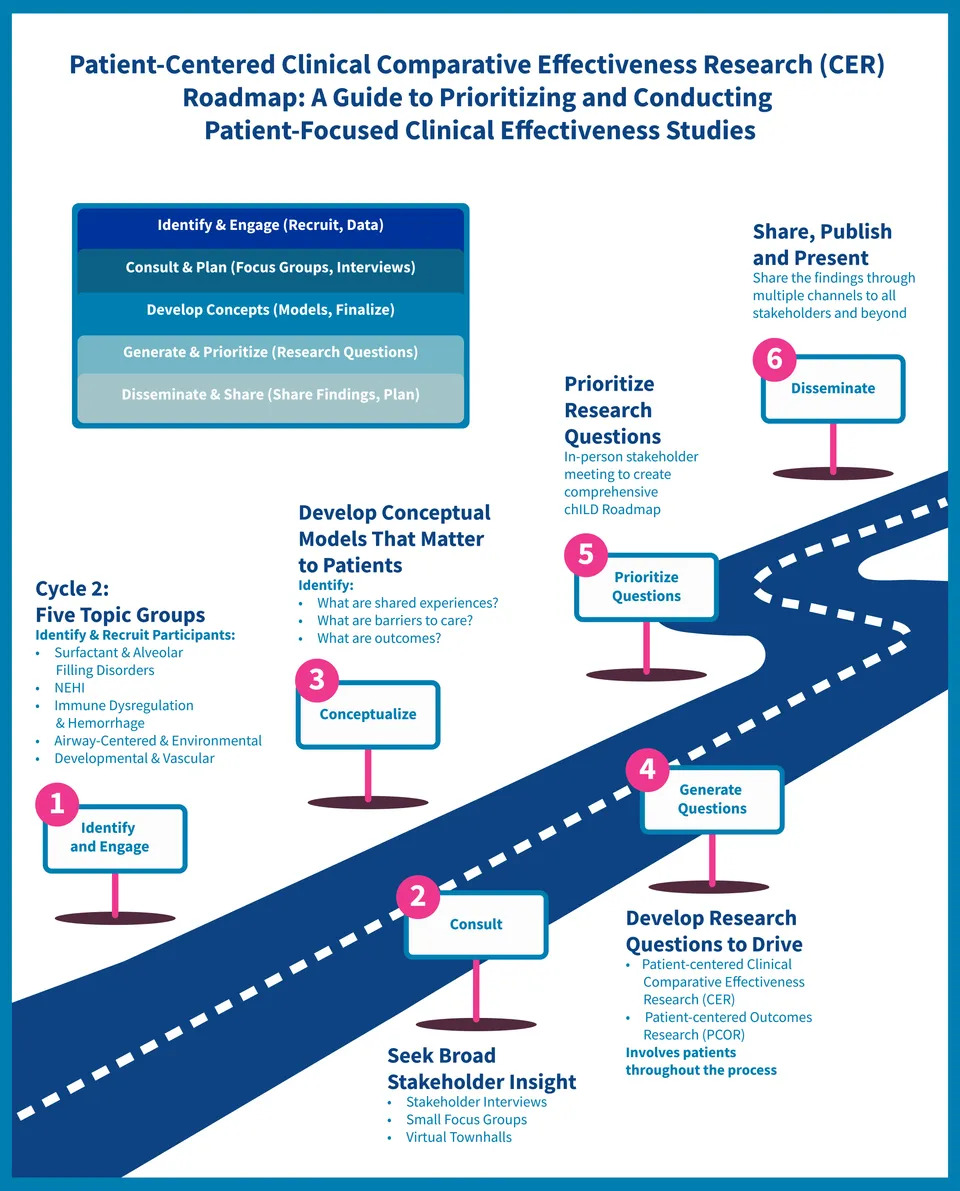
- Expert Stakeholder Interviews & Focus Groups (May – Oct 2026)
- Disease-specific Family Topic Groups (Sept 2026 – Jan 2027)
- New program development working groups launching in Year 2
Family Topic Group Categories
Year 2 family groups are organized by diagnosis type. Groups forming in each of the following areas:
- ①Surfactant & Alveolar Filling Disorders — SP-B, SP-C, SP-D, ABCA3, TTF-1, PAP, and related conditions
- ②NEHI — Neuroendocrine cell hyperplasia of infancy
- ③Immune Dysregulation & Hemorrhage — COPA, SAVI, pulmonary hemorrhage syndromes, and multi-system immune conditions
- ④Airway-Centered & Environmental — Post-infectious bronchiolitis obliterans (PIBO), airway-centered diseases, and exposure-related chILD
- ⑤Developmental & Vascular — Developmental dysplasia, pulmonary vascular disorders, alveolar simplification, and growth abnormalities
Don't see your diagnosis listed? Sign up anyway — we want to hear from you.
Sign Up — Family Topic Group →Get Involved in Year 2!
Join a Working Group or Focus Group!
Stakeholder Interviews & Expert Focus Groups
One-time · 1–4 hours
One-time consultations on priority topics. Your input directly informs the research questions families develop.
- Physicians, nurses & allied health professionals
- Researchers & bioinformatics experts
- Industry partners (pharma, device, diagnostics, health IT)
- Payers, policymakers & health systems leaders
- Rare disease advocates & patient organization leaders
Oxygen Management
Oxygen is a lifeline for many children with chILD — but access, equipment, and management vary widely. This group will work to define best practices and identify research priorities around supplemental oxygen use in chILD.
- Families of children requiring supplemental oxygen
- Patients managing oxygen at home or school
- Clinicians, respiratory therapists & DME specialists
New in Year 2: Program Development Working Groups
We are launching two new working groups to begin developing real programs for the chILD community.
Transition to Adulthood
Young adults with chILD often fall through the cracks when moving from pediatric to adult care. This group will help define what a real transition support program looks like.
- Young adults (13+) living with chILD
- Parents of teens & young adults in transition
- Clinicians, social workers & transition specialists
Undiagnosed chILD
Families without a diagnosis face profound challenges — navigating emergency care, fighting for coverage, and living with chronic uncertainty. This group will build infrastructure to better support these families.
- Caregivers or patients seeking a diagnosis for 1+ year
- Clinicians in rare or undiagnosed conditions
- Researchers in diagnostics, genetics & rare disease
Working group time commitments are still being finalized. Express your interest and we'll be in touch.